Oxfordshire pioneers hydrogen-powered highways maintenance with dual-fuel vehicle trial
- Safer Highways
- 7 hours ago
- 3 min read

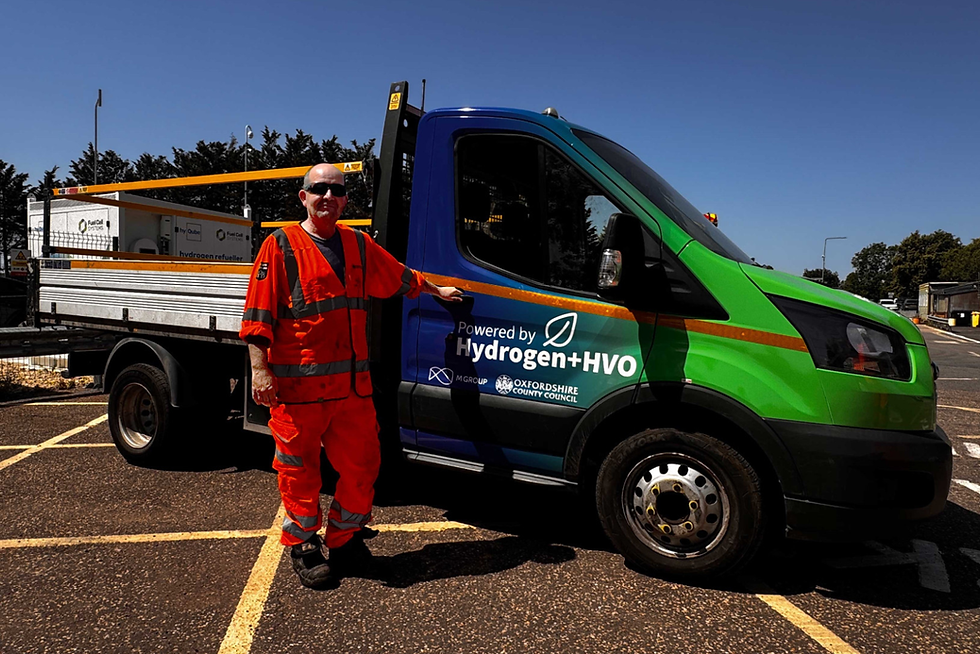
Oxfordshire County Council has become the first local authority in England to introduce a dual-fuel hydrogen highways maintenance vehicle, marking a significant milestone in the drive to decarbonise road maintenance operations.
The new 3.5-tonne maintenance truck, which operates using a combination of hydrogen and hydrotreated vegetable oil (HVO), has entered service with M Group, the council's principal highways contractor, as part of a trial aimed at reducing emissions from frontline highway maintenance.
The vehicle is also the first hydrogen-powered asset to join M Group's nationwide fleet of approximately 10,000 vehicles, representing an important step in the company's wider journey towards net zero.
Retrofitting existing vehicles
Rather than purchasing a new vehicle, the project has focused on extending the life of an existing maintenance truck.
Hydrogen technology specialist ULEMCo has converted a conventional vehicle to operate on the dual-fuel system, allowing hydrogen to be used alongside HVO while retaining the practicality required for everyday highway maintenance.
M Group has funded the retrofit and confirmed that a second converted vehicle, expected to be a medium or heavy goods vehicle, is scheduled to join the Oxfordshire fleet in early 2027.
Lower emissions for highway operations
The trial forms part of both organisations' commitments to reducing greenhouse gas emissions from transport operations.
Compared with conventional diesel, the combination of hydrogen and HVO is expected to reduce tailpipe carbon emissions by around 30–40%, while also lowering emissions of pollutants such as nitrogen oxides that contribute to poorer air quality.
The vehicles will continue to perform routine highways duties, transporting maintenance teams, equipment and materials to sites across Oxfordshire for road repairs and improvement works.
Gathering operational data
As well as evaluating environmental performance, the trial will assess how the technology performs in day-to-day operations.
Highways teams have received specialist training covering vehicle operation, refuelling procedures, maintenance requirements and safety protocols.
Throughout the trial, data will be collected on fuel efficiency, operating costs, reliability and driver experience to help determine whether hydrogen-powered maintenance vehicles could be deployed more widely in future.
Supporting long-term decarbonisation
Richard Lovewell, Business Director at M Group, said the project reflected the company's ambition to reduce emissions across its operations.
"M Group Highways has an ambitious target of being net zero carbon by 2040. We're excited to be working with Oxfordshire County Council to trial practical solutions that can accelerate the journey to net zero."
Councillor Liz Leffman, Oxfordshire County Council's Cabinet Member for Highways Construction and Repair, said innovation would play a key role in addressing climate change.
"The climate emergency is the biggest challenge the planet faces, and we are committed to not only reaching our own net zero target as a council by 2030 but to enabling Oxfordshire to be carbon neutral well ahead of 2050.
"We are delighted to be working with M Group to trial this innovative technology which will mean lower emissions and cleaner air across Oxfordshire."
A potential model for the wider sector
Heavy goods vehicles and maintenance trucks account for a significant proportion of road transport emissions, making them an important focus for decarbonisation efforts.
By trialling hydrogen technology within routine highways maintenance, Oxfordshire hopes to better understand whether dual-fuel vehicles can provide a practical low-carbon alternative for local authority fleets while supporting the wider transition towards cleaner transport across the UK.
The project also demonstrates how retrofitting existing vehicles, rather than replacing entire fleets, could offer a cost-effective pathway to reducing emissions while extending the operational life of essential highway maintenance equipment.


Comments