Ongoing Closure of Hammersmith Bridge Draws Continued Criticism
- Safer Highways
- Apr 25
- 2 min read

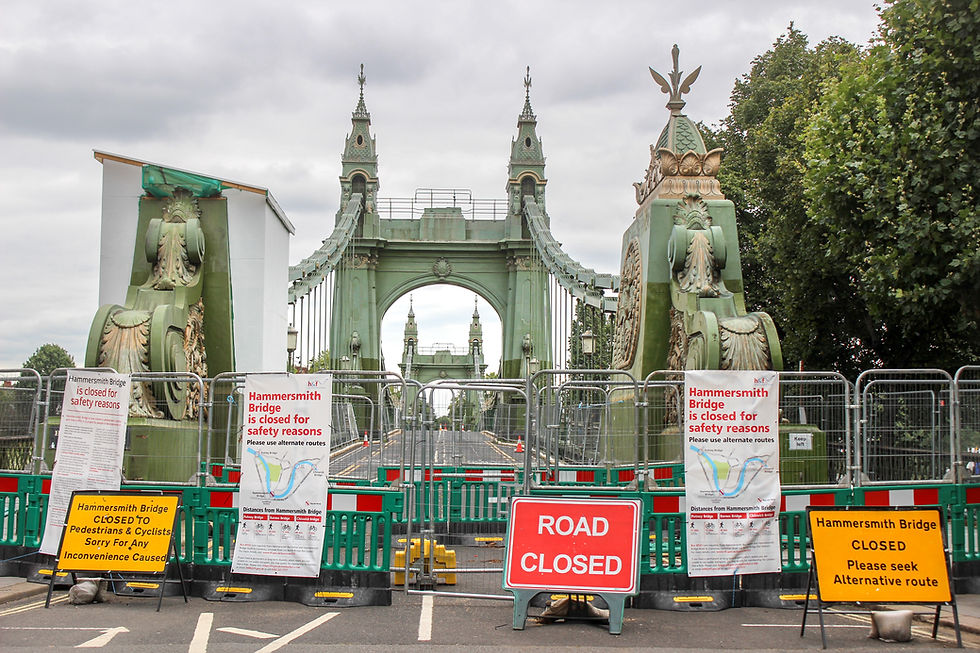
Seven years on from its closure to vehicles, Hammersmith Bridge remains a focal point of concern for politicians and local communities, with growing frustration over the lack of a long-term resolution.
The historic suspension bridge, which dates back to 1827 and holds Grade II* listed status, was closed in April 2019 after structural issues—specifically microfractures—were identified. Although it reopened last year to pedestrians, cyclists and other non-motorised users, it is still not accessible to road traffic.
The prolonged situation was debated in Parliament this week, where MPs highlighted the sustained impact on west London residents. Fleur Anderson, MP for Putney, pointed to the seven-year anniversary of the closure as a stark reminder of the disruption caused and the absence of a clear, funded plan to restore full access.
She noted that the bridge previously carried around 22,000 vehicles per day, and its closure has not reduced demand but instead diverted traffic onto surrounding routes. This has led to persistent congestion and longer journey times across nearby areas including Putney, Barnes and Richmond.

Similar concerns were raised by Sarah Olney, MP for Richmond Park, who drew attention to the financial burden placed on the local authority. Since 2019, Hammersmith and Fulham Council has spent close to £50M on maintaining the structure, while progress towards a comprehensive repair has remained slow.
The Department for Transport has provided some funding support, totalling £17M to date. This includes £4.7M allocated in early 2025 for essential works to stabilise key elements of the bridge, allowing it to remain open for non-vehicular use.
Responding to the debate, Transport Minister Simon Lightwood reiterated that ownership and responsibility for the bridge lie with the London Borough of Hammersmith and Fulham. However, he confirmed that the government has continued to work alongside the council and Transport for London to maintain safety and explore future options.
He also highlighted the re-establishment of the Hammersmith Bridge taskforce, which is intended to bring together stakeholders to reassess potential engineering solutions and funding approaches.
Despite these developments, uncertainty remains over when—or if—the bridge will reopen fully. The situation continues to underline the challenges of maintaining ageing infrastructure while balancing funding responsibilities between local and national bodies.


Comments