The Friday Blog | Hammersmith Bridge Shows Why Government Can No Longer Dodge Infrastructure Failure
- Kevin Robinson
- Feb 5
- 3 min read
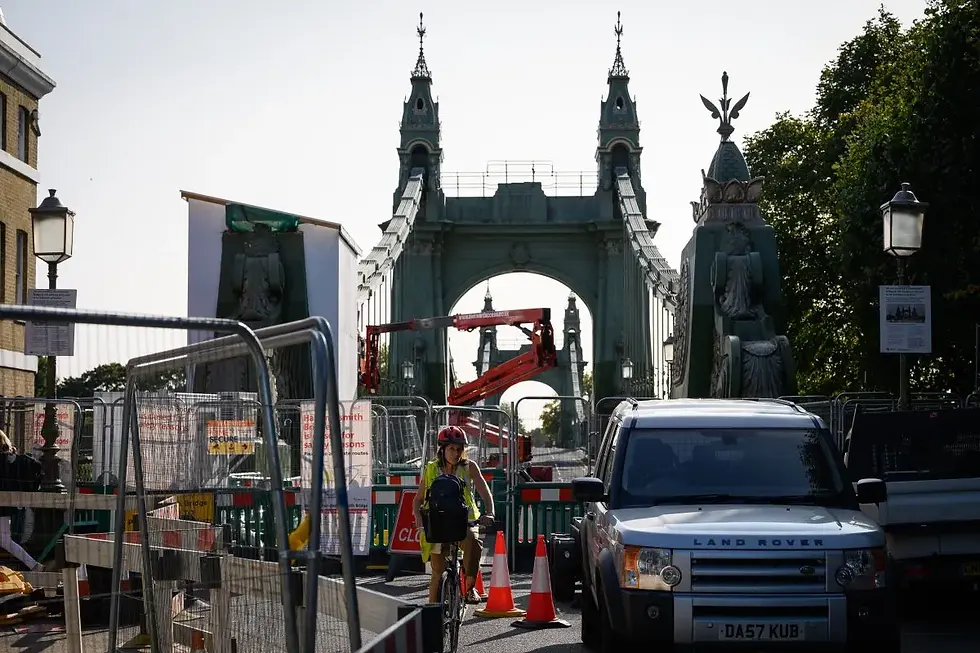
The seven-year closure of Hammersmith Bridge is more than an inconvenience.
It has become a symbol of national decline — and of a political system that keeps searching for someone else to pick up the bill.
If all unrealistic options are ruled out, only one conclusion remains: the government must take responsibility for fixing Hammersmith Bridge.
What should be a simple river crossing has instead trapped communities in logistical limbo. Journeys that once took minutes now require long detours. Everyday routines — visiting family, commuting to work, attending school — have been quietly reshaped by a bridge that no longer functions. Relationships fray. Neighbourhoods drift apart. The closure represents a failure not just of concrete and steel, but of governance.
The contrast with the past is stark. When the original 1824 bridge failed, the Victorians replaced it swiftly. Today, despite vastly greater national wealth, no authority appears willing — or able — to fund a replacement. The result is paralysis.
Responsibility technically lies with Hammersmith and Fulham Council, the legal owner of the bridge. But the idea that a London borough could find £250m for a replacement is pure fantasy. Legal ownership does not create financial capacity. This option can be dismissed immediately.
One level up sits the Greater London Authority. Historically, Hammersmith Bridge belonged to London-wide bodies until it was handed to the borough following the abolition of the Greater London Council. When the GLA was re-established in 2000, many assumed it would once again take responsibility for strategic assets like this.
The GLA undoubtedly has deeper pockets than a borough. It funded major works on the Hammersmith Flyover in 2015. But those pockets are already overstretched. London’s infrastructure backlog runs into the billions. Structures like the Westway have had speed limits slashed due to safety concerns, while Transport for London’s maintenance shortfall is growing by around £400m a year. Rather than being the bridge’s saviour, TfL is increasingly a list of future closures waiting to happen.
And Hammersmith is not an isolated case. Broadmead Road bridge in Redbridge, a modern structure over the Central Line, was closed indefinitely to motor vehicles in 2023 for the same reason: structural failure and no affordable fix. The pattern is clear.
Some suggest the City Bridge Foundation should step in. For centuries, it has successfully maintained London’s central bridges using funds generated from historic tolls and rents. But forcing it to absorb Hammersmith Bridge would be both unfair and shortsighted. It would punish one of the few institutions that has actually looked after its assets properly — and merely shift the decay elsewhere.
That leaves only one option: central government.
Successive governments have been reluctant to intervene, fearing they would set a precedent by rescuing failing local infrastructure. The concern about moral hazard is understandable. But precedent is irrelevant when there is no alternative. If government refuses to act, bridges will remain closed, decay further, and eventually fail outright.
This is not just about Hammersmith. It is about what kind of country Britain intends to be. A nation that cannot maintain its bridges is a nation choosing managed decline.
Perhaps the most troubling possibility is that government inaction reflects a deeper truth — that Britain no longer believes it can afford to build and maintain vital infrastructure. That idea should alarm us. Every year of delay strengthens the case for pessimism.
Yet there is still time to choose differently. Britain’s crumbling Victorian infrastructure should be a wake-up call, not a shrug. Investing in bridges is not nostalgia — it is a commitment to productivity, growth and basic national competence.
Fixing Hammersmith Bridge will not solve every problem. But refusing to fix it guarantees many more. And if nothing else, renewed belief in growth might at least achieve one simple outcome: a bridge that works.


Comments