Port of Liverpool Achieves Key Milestone in Major Solar Energy Project
- Safer Highways
- Apr 29
- 2 min read

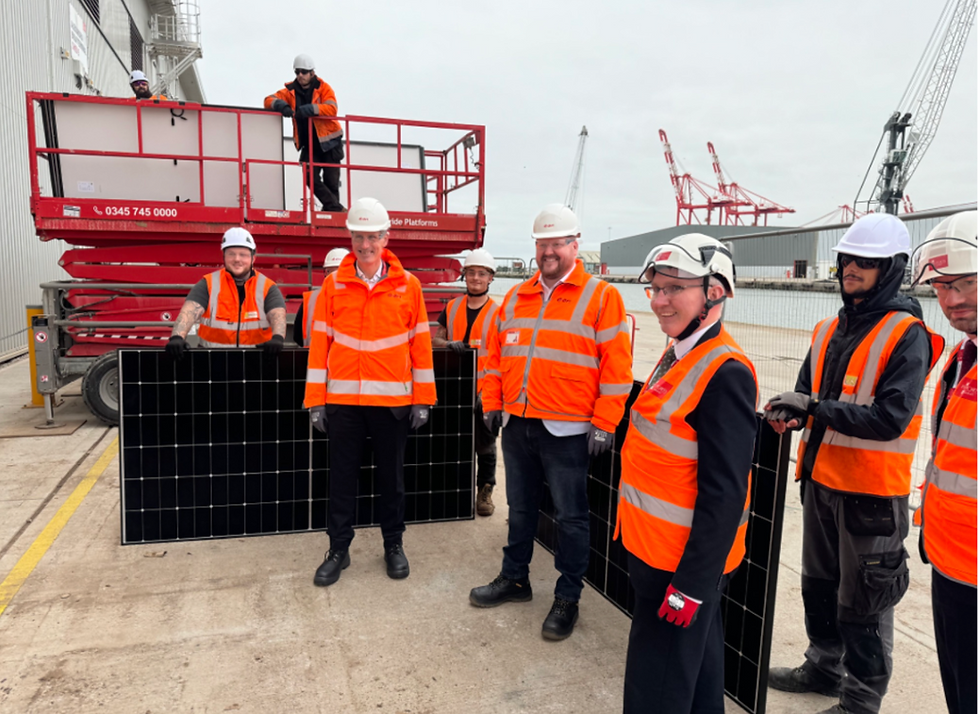
A major renewable energy project at the Port of Liverpool has reached an important milestone, with the first electricity now being generated from a large-scale rooftop solar installation.
The scheme, delivered through a partnership between Peel Ports Group and E.ON, involves the installation of thousands of solar panels on the roof of the Alexandra Dock warehouse—known as “Alex Shed”—which spans nearly 260,000 square feet. This marks the initial phase of what is set to become the UK’s largest roof-mounted solar array.
So far, almost 7,000 panels have been installed and connected to the grid. Over time, the project will expand significantly, with plans to deploy up to 48,000 panels across multiple buildings throughout the port.
The initiative forms part of a long-term, 25-year agreement between Peel Ports Group and E.ON. Once fully operational, the solar network is expected to cut carbon emissions by around 4,700 tonnes annually—equivalent to removing more than 1,600 cars from the road. The project will play a key role in helping the port operator meet its target of achieving net zero emissions by 2040.
E.ON’s Chief Operating Officer for Energy Solutions, Vijay Tank, highlighted the importance of decarbonising major infrastructure sites such as ports, noting that projects like this are essential to meeting both environmental and economic objectives. He also pointed to the long-standing partnership between E.ON and Peel Ports as a foundation for delivering future energy initiatives.
For Peel Ports, the grid connection represents a significant step towards its wider sustainability goals. The organisation is aiming to source half of its energy from renewable sources by 2030.
When complete, the solar installation is expected to generate up to 25MW of power—enough to meet around a quarter of the port’s annual electricity demand and comparable to the energy needs of more than 10,000 UK homes.
The project has been fully funded and delivered by E.ON, with a commitment to using local contractors for both installation and ongoing maintenance over the lifetime of the agreement.
In line with the port’s environmental strategy, the development has been carried out entirely within its existing footprint, making use of available rooftop space rather than requiring new land. Additionally, materials and equipment have been transported by sea, helping to minimise disruption to surrounding communities.
Lewis McIntyre, Managing Director of Port Services at Peel Ports Group, described the milestone as a major step forward in decarbonising port operations. He noted that converting warehouse roofs into renewable energy assets demonstrates how large-scale infrastructure can be adapted to support sustainability goals while continuing to drive economic activity.
He also pointed to the organisation’s broader progress, with Peel Ports having reduced its Scope 1 and 2 emissions by nearly half over the past five years.
The project is being positioned as an example of how ports can contribute to the energy transition—by making better use of existing infrastructure, working collaboratively with partners, and delivering long-term environmental and economic benefits.


Comments