The Friday Blog | Could the Norwegian Approach Revive Plans for a Peak District Road Tunnel?
- Safer Highways
- 4 minutes ago
- 3 min read


A long-standing vision to transform road links between Manchester and Sheffield is back in the spotlight, with supporters claiming that adopting Norwegian tunnelling techniques could dramatically reduce construction costs and breathe new life into a project previously considered financially out of reach.
The proposal, developed by infrastructure group Future Works, would see a 14-mile (22km) dual carriageway tunnelconstructed beneath the Peak District National Park, creating a new high-capacity route between two of the North's largest cities.
While the concept itself is not new, its promoters argue that the way Britain builds tunnels is.
Rather than relying on traditional UK construction methods, they believe the project could become commercially viable by embracing the engineering techniques that have enabled Norway to build some of the world's most challenging road tunnels quickly and comparatively cost-effectively.
Learning from Norway
Norway has spent decades perfecting the construction of long mountain tunnels through some of Europe's most unforgiving terrain.
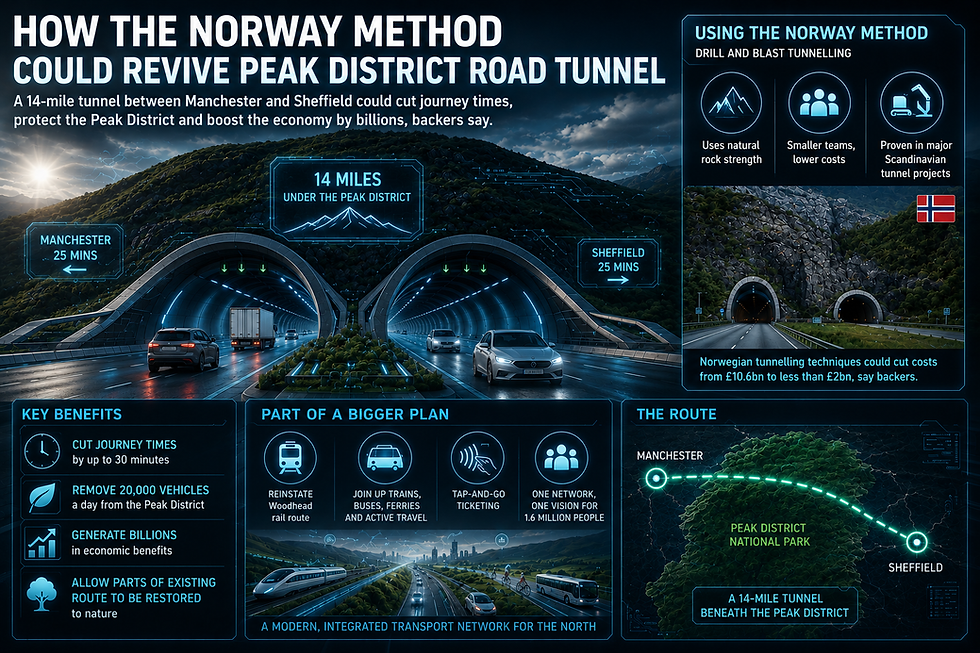
Instead of relying heavily on enormous tunnel boring machines, Norwegian engineers frequently use the 'drill and blast'technique, combining controlled blasting with modern rock reinforcement systems that make use of the surrounding geology rather than extensive concrete linings.
Supporters argue the approach requires smaller specialist teams, offers greater flexibility through varying ground conditions and significantly reduces construction costs where suitable rock formations exist.
Future Works believes that adopting this Scandinavian methodology could fundamentally change the economics of a Peak District crossing.
A dramatic reduction in cost
Previous government studies estimated that a trans-Pennine road tunnel could cost around £10.6 billion using conventional UK delivery methods.
Future Works argues that by adopting the Norwegian approach, the scheme could potentially be delivered for less than £2 billion.
If those estimates prove achievable, the financial case for the project changes considerably.
The organisation believes lower construction costs could allow the tunnel to be funded through long-term toll revenues, reducing or even eliminating the need for direct government funding.
More than just another road
Supporters insist the proposal is about far more than reducing journey times.
Currently around 20,000 vehicles travel across the Peak District each day, with freight traffic placing increasing pressure on roads originally never designed for modern traffic volumes.

By moving through traffic underground, proponents say large sections of the existing route could be restored to the natural landscape, reducing noise, emissions and visual intrusion within one of Britain's most cherished national parks.
The scheme could also unlock wider transport opportunities.
Future Works believes relocating overhead electricity infrastructure as part of the project could create the conditions needed to restore the long-discussed Woodhead rail route, delivering improved road and rail connectivity between Manchester and Sheffield.
Regional interest grows
The proposal has attracted interest from regional leaders concerned about east-west connectivity across the Midlands and the North.
The East Midlands Combined County Authority (EMCCA) said it welcomed discussion around new approaches that could reduce infrastructure costs while accelerating delivery.

A spokesperson said improving transport links remains essential to supporting economic growth, adding that innovative delivery methods and alternative funding models deserve consideration alongside existing priorities.
However, the authority stressed that any future proposal would ultimately need to demonstrate affordability, public value and environmental responsibility.
Government remains cautious
Despite renewed attention surrounding the proposal, ministers have reiterated that there are currently no plans to pursue a trans-Pennine road tunnel.
The Department for Transport continues to cite both financial and environmental concerns, maintaining that improvements to the existing A628/A616 corridor remain the preferred approach through National Highways' third Road Investment Strategy (RIS3).
For now, the tunnel remains an ambitious concept rather than an approved project.
A bigger question for British infrastructure
Whether or not the Peak District tunnel is ultimately built, the proposal raises a broader question about how major infrastructure is delivered in the UK.
Countries such as Norway have demonstrated that long road tunnels can be constructed safely, efficiently and at comparatively low cost by adapting engineering techniques to suit local geology rather than relying on one standard delivery model.
As Britain grapples with ageing infrastructure, rising construction costs and increasing pressure on public finances, there may be lessons worth learning.
The question is no longer simply whether the Peak District needs better connections between Manchester and Sheffield.
It is whether the UK is prepared to rethink how it delivers major infrastructure—and whether a Norwegian approach could provide the blueprint for doing so.



Comments