Derby residents call for empty A38 properties to be brought back into use
- Safer Highways
- 44 minutes ago
- 3 min read

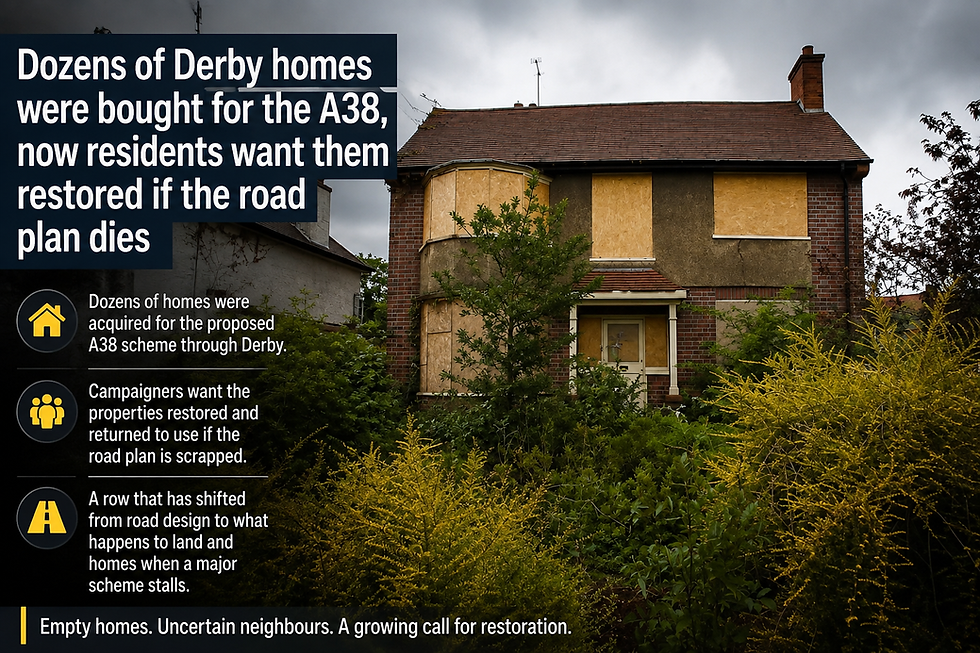
Homes acquired to make way for National Highways’ proposed A38 improvements through Derby could become the focus of a new regeneration challenge if the long-running road scheme does not proceed.
Attention surrounding the future of the A38 in Derby is turning from what might be built to what could be left behind, as residents call for properties purchased for the highway scheme to be restored and returned to residential use if the plans are abandoned.
Dozens of homes have been acquired in connection with proposals to improve the strategic route through the city, leaving properties empty while the future of the scheme has remained uncertain.
For communities living alongside the route, those houses have become one of the most visible consequences of the lengthy infrastructure planning process.
Campaigners now argue that if the road improvements are ultimately cancelled, there should be a clear programme for bringing affected properties back into use rather than allowing them to remain vacant.
From highways scheme to housing question
The issue illustrates a challenge that can accompany major infrastructure projects long before construction begins.
Land and property sometimes need to be acquired in advance to protect the route of a proposed scheme and ensure that construction can proceed if the necessary approvals and funding are secured.
For project promoters, securing property can be an essential part of preparing a major scheme.
For neighbouring communities, however, the result can be years of uncertainty.
Once previously occupied houses become vacant, the effects can extend beyond the individual properties. Residents can find themselves living alongside boarded-up homes, while concerns can emerge around maintenance, appearance, security and the longer-term character of a neighbourhood.
The debate in Derby is therefore increasingly about what should happen if land assembled for infrastructure is no longer required for that purpose.
A38 proposals have cast a long shadow
The A38 is an important strategic connection through the Midlands, carrying both local journeys and longer-distance traffic through Derby.
Proposals to improve the route have been driven by concerns including congestion, junction capacity, safety and the ability of the network to accommodate future demand.
But delivering major improvements through an established urban area inevitably creates consequences beyond the carriageway itself.
Property acquisition, potential demolition, construction disruption, noise and changes to local access can all become significant considerations when developing a scheme.
In Derby, the length of time surrounding the proposals has made the future of acquired properties an increasingly important issue in its own right.
If the scheme proceeds, the homes and land would remain part of the project's planned footprint.
If it does not, residents want to see a different future established quickly.
Restoring properties would bring its own challenges
Returning acquired homes to residential use would not necessarily be immediate.
Properties that have remained empty may require inspections and potentially substantial refurbishment before they can be occupied again.
Decisions would also have to be taken about ownership and disposal, including whether properties should be sold on the open market or whether opportunities exist for them to contribute to local housing provision.
There would also be questions surrounding land acquired for other elements of the highway scheme.
Nevertheless, with housing demand remaining significant, campaigners believe leaving usable properties vacant would become increasingly difficult to justify if they are no longer required for the A38.
Wider lesson for major infrastructure projects
The situation highlights an often overlooked part of planning major highways schemes: managing the consequences when projects are delayed, redesigned or cancelled.
Large infrastructure programmes are typically measured through construction costs, journey-time benefits, traffic capacity and economic returns.
The effects on communities can begin much earlier.
Property acquisition can alter neighbourhoods years before construction starts, meaning uncertainty over a project's future can itself create a lasting impact.
That places greater importance on having an exit strategy for land and property if circumstances change.
It could become increasingly relevant across the highways sector as investment priorities shift towards maintaining and renewing existing infrastructure and government reviews which major enhancement schemes should continue.
For Derby residents, however, the immediate issue is considerably simpler.
If the A38 improvements go ahead, the properties have a defined purpose within the project. If the scheme is abandoned, residents want the uncertainty to end with it – and the empty houses restored so they can once again become homes.


Comments