AI-Powered Research Aims to Improve Transport Decarbonisation in the West Midlands
- Safer Highways
- Jun 2
- 3 min read

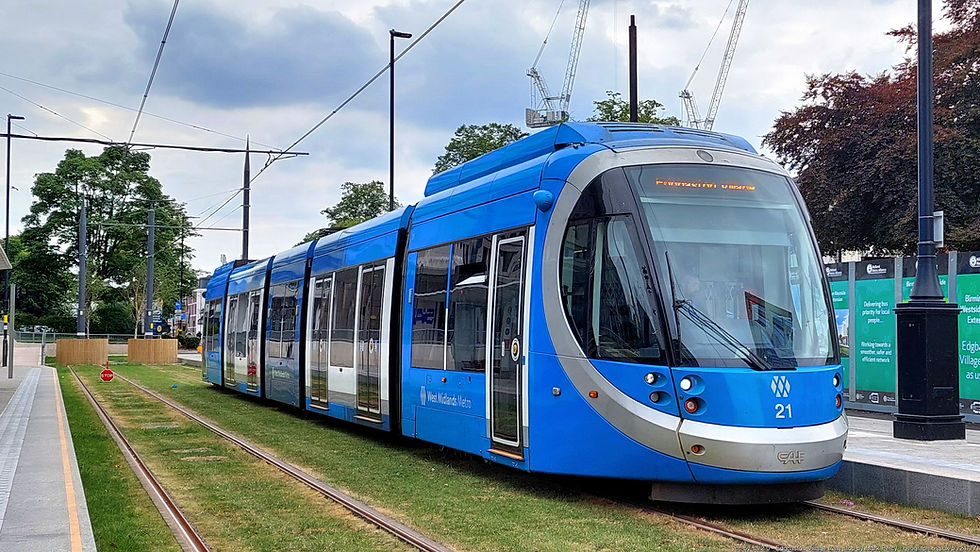
Researchers are harnessing artificial intelligence to create more realistic transport simulations that better reflect how people make travel decisions, helping policymakers identify effective ways to reduce carbon emissions from transport.
The work forms part of a wider transport decarbonisation project focused on the West Midlands, where researchers are exploring strategies to encourage greater use of public transport, cycling and walking while reducing reliance on private cars.
Scientists from Heriot-Watt University are using artificial intelligence to enhance a synthetic population model representing around three million residents across the region. Their aim is to ensure simulated individuals behave more like real people when responding to transport policy changes and infrastructure improvements.
The research draws on a set of twelve transport user personas developed by the Department for Transport (DfT). These personas represent a range of traveller types, each with different attitudes, habits and transport preferences.
By integrating these behavioural profiles into large-scale transport models, researchers hope to gain a more accurate understanding of how different groups might respond to measures such as lower bus fares, improved cycling infrastructure or changes to public transport services.
Dr Shiqi Sun explained that traditional transport simulations are effective at modelling network operations but often struggle to capture the complexity of human behaviour.
In a real-world transport system, travellers make decisions based on a wide variety of personal circumstances and preferences. By incorporating more realistic behavioural characteristics, researchers can better predict how people may respond to interventions designed to reduce emissions and shift travel habits.
The project is being undertaken through TransiT, a national research hub dedicated to accelerating transport decarbonisation through the use of digital twins. The initiative brings together eight universities and nearly 70 industry partners and is jointly led by Heriot-Watt University and the University of Glasgow. Funding is provided by the Engineering and Physical Sciences Research Council (EPSRC) with support from the Department for Transport.
Synthetic populations are widely used in transport planning because they allow researchers to model demographic characteristics such as age, income and location without relying on personal data. However, they can struggle to represent the diversity of human attitudes and behaviours that influence travel choices.
To address this limitation, researcher Dr Jingjun Li proposed linking the synthetic population to the DfT's transport personas. While manually assigning behavioural profiles to millions of simulated individuals would be impractical, the research team has developed an automated solution using artificial intelligence.
Dr Sun's approach combines machine learning with Large Language Models (LLMs), enabling the system to analyse multiple data points and assign appropriate behavioural characteristics to each individual within the simulation.
The team has named the methodology Active LLM Fusion (ALF), reflecting its ability to continuously improve its predictions as additional data is introduced.
According to the researchers, the system becomes more accurate over time, allowing transport simulations to better reflect real-world decision-making while significantly reducing the time required to build and update large-scale models.
Although the current focus is on transport decarbonisation, the researchers believe the technology has applications beyond mobility planning. Similar techniques could be used in sectors such as healthcare, urban development and public policy, where understanding the behaviour of different population groups is critical to effective decision-making.
The project highlights the growing role of artificial intelligence and digital twin technologies in supporting the transition to more sustainable transport systems and helping policymakers evaluate the potential impacts of future investment and policy decisions.


A brilliant and forward-thinking initiative! Utilizing the predictive power of AI to tackle transport decarbonisation is exactly the kind of innovation Fnaf needed to meet our climate goals. The West Midlands is setting a fantastic blueprint here—proving that data-driven insights can transform complex transit networks into cleaner, more efficient systems.