ADEPT Urges Government Action to Ensure Fair Access to EV Charging
- Safer Highways
- 7 hours ago
- 2 min read

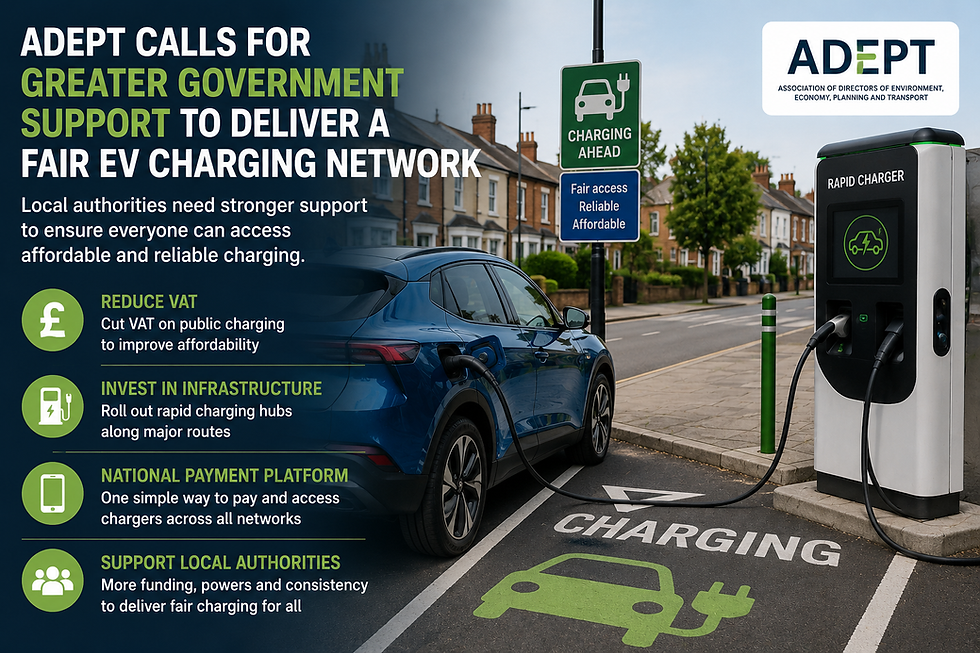
The Association of Directors of Environment, Economy, Planning and Transport (ADEPT) is calling on the Government to provide greater support for local authorities as they work to expand electric vehicle charging infrastructure across the UK.
In a newly published policy position statement, the organisation warns that the country's transition to electric vehicles could be hindered unless charging networks become more accessible, affordable and consistent for all users.
The appeal comes as electric vehicle adoption continues to accelerate. More than 1.9 million fully electric vehicles are now operating on UK roads, while EVs accounted for almost one in four new vehicle registrations during 2025.
Despite this growth, ADEPT believes significant challenges remain, particularly for households that do not have access to private driveways or off-street parking.
Public Charging Cost Concerns
According to ADEPT, between eight and nine million households across the UK rely primarily on public charging facilities because they are unable to install home charging equipment.
The organisation argues that these motorists often face considerably higher charging costs, with public charging sometimes costing more than three times as much as charging a vehicle at home.
ADEPT warns that this disparity risks creating an uneven transition to electric mobility, where some drivers face substantially higher running costs simply because of where they live.
Calls for National Support
To address these concerns, the organisation is urging the Government to introduce a series of measures designed to improve affordability and accessibility.
Among its recommendations are a reduction in VAT on public charging, greater investment in rapid charging hubs along strategic transport corridors and the development of a national payment platform that would allow motorists to access chargers from multiple operators through a single system.
ADEPT believes such measures would help simplify the charging experience while making electric vehicle ownership more practical for a broader range of households.
Supporting Local Authorities
The organisation also argues that local authorities require stronger backing from central government to successfully plan and deliver charging infrastructure within their communities.
ADEPT says councils are playing a critical role in the rollout of public charging networks but need greater funding certainty, clearer policy direction and additional powers to meet growing demand.
Ann Carruthers, former Chair of ADEPT’s Transport & Connectivity Board and former President of the organisation, said stronger collaboration between local and national government is essential to ensuring the transition to electric vehicles is delivered fairly.
She argued that councils need greater resources and consistency from government if they are to provide charging infrastructure that meets the needs of residents and businesses alike.
Avoiding a Two-Tier EV Transition
ADEPT's latest position highlights concerns that uneven access to charging infrastructure could become a significant barrier to wider electric vehicle adoption.
Without further intervention, the organisation believes motorists who rely exclusively on public charging may face higher costs and fewer charging opportunities than those able to charge at home.
As the UK continues its journey towards a lower-emission transport system, ADEPT is calling for a coordinated national approach that supports local delivery while ensuring that access to electric vehicle charging is fair, reliable and affordable for all drivers.


Comments